
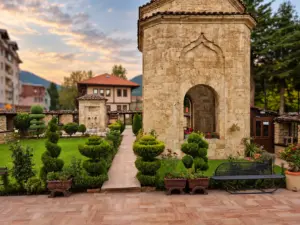


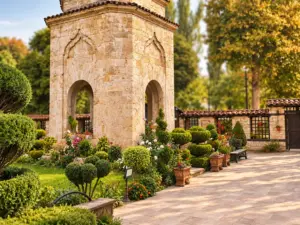
Even before you enter the famous Painted Mosque in Tetovo, there is something special to discover. Surrounding the building is a beautiful garden with trees, flowers, and small pathways. Here, you can escape the busy streets of the city for a moment. But this garden is more than just a peaceful place. It also tells part of the mosque's history.
One of the first things you may notice is the fountain. It reminds us of an important Islamic tradition: the ritual washing before prayer, known as Wudu. During this washing, worshippers clean their hands, face, arms, and feet according to certain rules. This prepares them for prayer, both physically and spiritually.
Another interesting feature of the garden is a small, open tomb with eight sides. This type of burial structure is called a türbe, a word that comes from Turkish.
Inside the türbe are the graves of two women, Hurshida and Mensure. They are believed to have been the founders and benefactors of the original mosque. This means they are thought to have contributed money or property to help build it.
The two women lived in the 15th century, when Tetovo was part of the Ottoman Empire. For many centuries, this empire ruled large parts of southeastern Europe.
Today, very little is known about the personal lives of Hurshida and Mensure. The exact year when the mosque was founded is also uncertain. Yet their names have survived through the centuries.
This makes their graves particularly remarkable. When we hear about historic mosques and monuments, the stories usually focus on powerful men, such as sultans and pashas. Here, however, two women are remembered for their important connection to the mosque's beginnings.
Take a moment to look around the garden. The fountain tells a story of faith and tradition. The two graves remind us of the mosque's early history and of women whose names have not been forgotten.
The story of the Painted Mosque begins right here in the garden, even before you discover its famous colorful decorations inside.
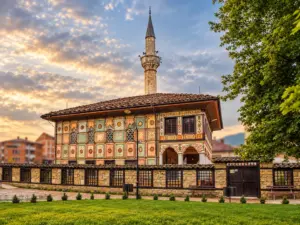
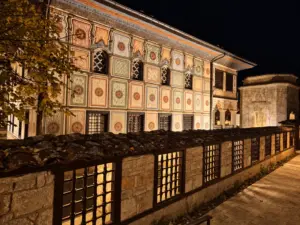
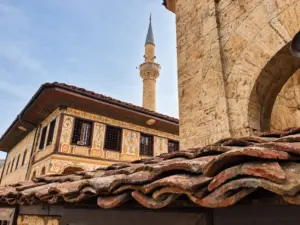
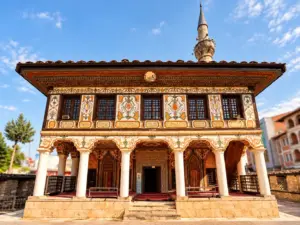
When you stand in front of the Painted Mosque in Tetovo, one thing immediately catches your eye: the building looks almost like a giant, colorful painting. Its outer walls are covered with countless patterns. You can discover stars, flowers, circles, diamonds, and many other shapes. Some resemble beautifully woven carpets, while others remind us of the decorations found in old, precious books.
These patterns are called ornaments. Take a closer look and you will notice that the shapes are not arranged randomly. Everything follows a careful design. Large and small patterns alternate, while many shapes repeat or appear as mirror images. Together, they create a wonderful combination of colors and forms.
The bright colors are especially striking. Red, yellow, green, and darker shades cover almost every part of the outer walls. Hardly any space is left undecorated.But how did this extraordinary building come to look this way?The mosque's history began in the 15th century, when Tetovo was part of the Ottoman Empire. However, the building received its present appearance much later.
In 1833 and 1834, Abdurrahman Pasha, a powerful Ottoman ruler in the region, ordered the mosque to be extensively renovated and beautifully painted. Skilled artists and craftsmen were needed for this impressive work.
There is even an interesting story about how the colors were made. According to local tradition, thousands of eggs were used to prepare the paint. Some stories mention an astonishing 30,000 eggs! Whether this is true remains unknown. But the story gives us an idea of how much effort may have gone into creating these decorations.
The roof also makes the Painted Mosque different from many other Ottoman mosques. Instead of a large, visible dome, it has a roof with four sloping sides. This makes the building look almost like an especially richly decorated house.
Right beside it stands the slender stone minaret. A minaret is the tower of a mosque. Traditionally, the muezzin called worshippers to prayer from this tower. This call is known as the Adhan.Compared with the colorful walls, the minaret looks quite simple. It may even date from an earlier period, preserving a reminder of the original mosque.
Looking at these two parts of the building, you can discover two different chapters of its long history: the simple stone tower and the magnificent paintings from the 19th century.
The Painted Mosque shows that a place of worship does not have to be enormous to leave a lasting impression. Sometimes, beautiful colors and a little imagination are enough to create something truly unforgettable.

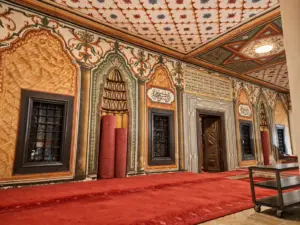


Before entering the prayer hall of the Painted Mosque, you pass through a covered entrance hall. It connects the open garden with the interior of the mosque. Take a moment to look around, because even this part of the building is a little work of art.
In Ottoman architecture, an entrance hall like this is often called a Hayat or Hajat. It provides shelter from the sun and rain and prepares visitors for entering the prayer hall.
Look at the columns supporting the roof. Their upper sections, known as capitals, are especially beautiful. They are decorated with colorful flowers, leaves, and curling plants. Some paintings even show flowers arranged in vases. It almost feels as though the garden outside continues to bloom across the painted surfaces.
There is plenty to discover on the walls and ceiling, too. Everywhere you look, you will find beautiful patterns, bright colors, and small painted details. Some decorations repeat, while others form little pictures of their own.
The artists created most of these paintings using a technique called secco painting. This means applying paint to plaster that has already dried. It allows artists to create very fine details, although the paintings are sensitive to moisture.
Now turn your attention to the entrance of the prayer hall. The doorway is surrounded by beautiful ornaments, with historical inscriptions above it. These tell us about the mosque's history and religious importance. Some also help historians understand when the building underwent its major renovation in the 19th century.
But this entrance hall is not only a place to admire art. It also has a practical purpose. Before entering the prayer hall, worshippers remove their shoes. This keeps the floor clean for prayer.
Take one last look around. Admire the painted columns, the flowers, and the colorful ceiling. Then continue through the doorway. Beyond it, perhaps the greatest surprise of the Painted Mosque is waiting for you.
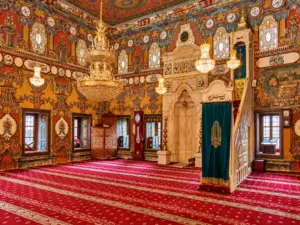

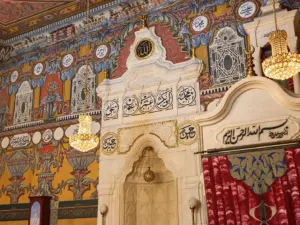
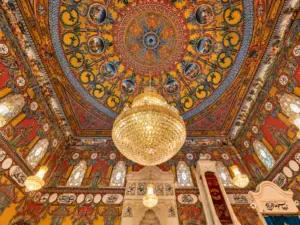
As soon as you enter the Painted Mosque, you are in for a surprise. The outside walls were already beautifully decorated, but inside, an even more colorful world awaits you. Almost every surface is covered with flowers, patterns, and paintings.
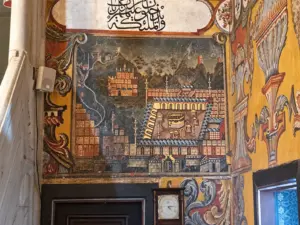
Take your time and look around. On the walls, arches, and ceiling, you will discover leaves, stars, circles, and flowing lines. Between them are paintings of buildings and landscapes. There are so many small details that you will notice something new every time you look.
The prayer hall is almost square. Above you rises a beautifully painted dome. You cannot see it from outside because it is hidden beneath a roof with four sloping sides.
The ceiling is especially impressive. Its patterns form large circles that lead toward the center. They almost make the room seem to open up toward the sky.Daylight enters through 30 windows arranged on two levels. The light makes the colors glow. As the position of the sun changes, some paintings appear brighter while others fall into shadow.
One particularly interesting feature is the paintings of cities and buildings. One of them shows Mecca, the holy city of Islam. This is where the Kaaba, the most important sacred site in Islam, is located.
Paintings of cities are rather unusual in mosques. More often, you will find geometric patterns, plants, and beautiful calligraphy. The Painted Mosque combines these traditional decorations with pictures of landscapes and architecture.
Many paintings show the influence of Ottoman Baroque art. This style combines Ottoman artistic traditions with European influences. It is known for its flowing shapes, rich decorations, and carefully painted details.But this magnificent room is, above all, a place of prayer.
On one wall, you will see a beautifully decorated niche called the mihrab. It indicates the direction of Mecca, known as the qibla, which Muslims face during prayer. Next to it stands the minbar, a pulpit reached by a small staircase. From here, the imam delivers the sermon during Friday prayers.
Both the mihrab and minbar are made of beautifully carved marble. Their light surfaces create a lovely contrast with the colorful walls.
Carpets cover the floor. Worshippers stand, bow, and kneel here during prayer. That is why everyone removes their shoes before entering.
The Painted Mosque is still used for worship today. It is not simply a tourist attraction, but a living place of faith. Please remain quiet and be considerate of anyone praying.
Before you leave, look up once more. The artists brought together countless flowers, stars, and lines to create one magnificent work of art. It shows the remarkable skill and imagination of the people who gave the mosque its present appearance almost 200 years ago.
© 2027 [www.guidemeplease.com]. All rights reserved.
The text, audio track, and photographs are protected by copyright.
This article has been researched and written with care, to the best of the author’s knowledge and belief.
Published: October 2026 · Version 1.0


